
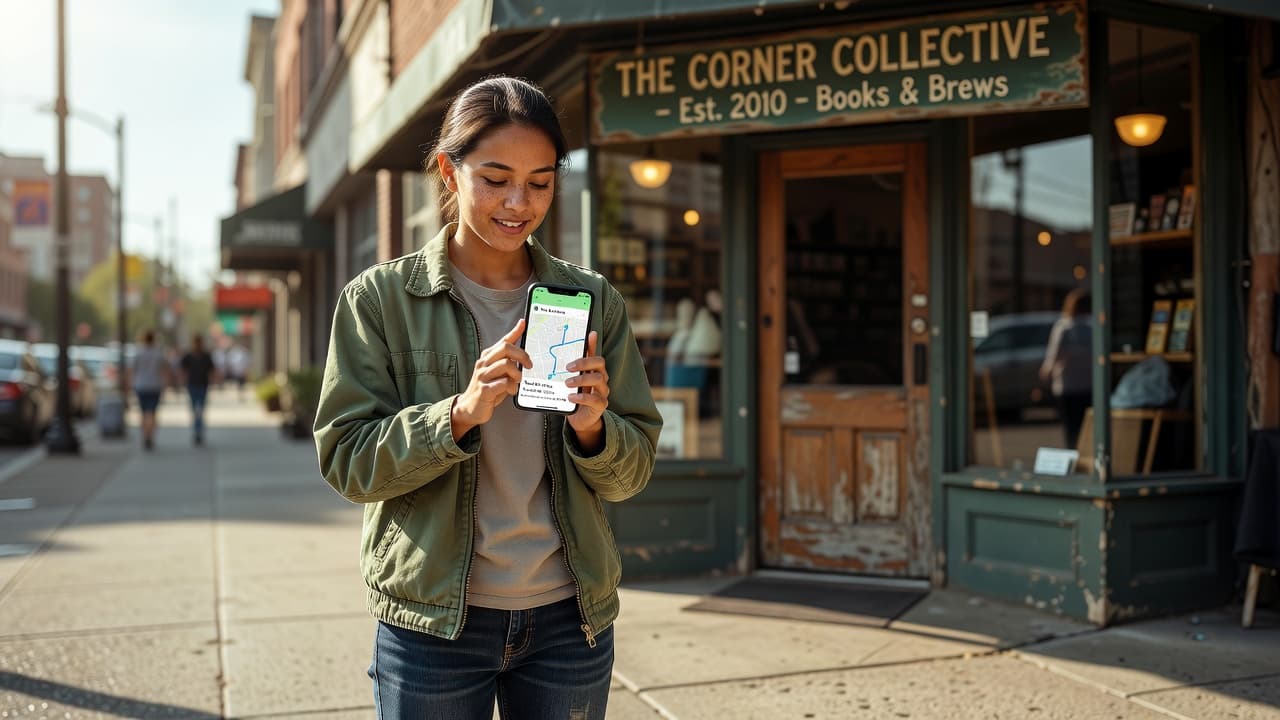
If someone opens Google Maps in Dallas today and types "quiet coffee shop near downtown with fast Wi-Fi and outlets, open past 9," Maps no longer hands them a list to sort through. It hands them a shortlist — three or four businesses it decided fit every part of that sentence.
That feature is Ask Maps, and here's the short version of how you win it: Ask Maps recommends the businesses whose attributes and review language most clearly match the exact question, not the ones that are simply closest. Proximity still matters, but a slightly farther business with a complete, specific profile now beats a closer one with a thin listing. If your Google Business Profile doesn't spell out what you offer in the same plain words people ask in, you're not in the running.
We've been watching this shift land on local clients since March, and the businesses that treated their profile like a live data feed are getting surfaced. The ones still treating it like a phone-book entry are quietly disappearing from the answer. Let me walk through what actually moves the needle.
What Ask Maps Actually Changed
Google launched Ask Maps on March 12, 2026 as a conversational layer built into the Maps app, running on Gemini. The old flow was: you type two words, Google shows the local pack ranked on relevance, distance, and prominence, and you filter. The new flow is: you ask a full, multi-condition question, and the model filters for you, then explains its picks.
That "explains its picks" part is the tell. Ask Maps will say something like "open until 10, strong Wi-Fi mentioned in reviews, quiet according to recent visitors." It's pulling from three places:
- Attributes you set on your Google Business Profile
- Review text left by customers
- Structured basics — hours, category, location, photos
The consequence is blunt. When an AI answer resolves the question inside Maps or Search and your business isn't cited, click-through can fall by more than 60%. You don't get to argue with the interface. Your only real move is to be the business it recommends.
If you've read our take on why content gets crawled but never cited, this is the same story playing out on the map instead of the search page: ranking and getting recommended have decoupled.
Attributes Are the New First-Line Filter
Here's the part most local businesses get wrong. They obsess over reviews and ranking, and leave half their attributes blank because filling them out feels like busywork.
Ask Maps reaches for attributes first. When someone asks for "good for remote work," the model looks for the businesses that literally have "Wi-Fi," "good for working on laptop," and relevant service options checked — before it weighs anything else. An empty attribute isn't neutral; it's a silent "no."
So the first job is boring and high-leverage: open your Google Business Profile and fill every attribute that honestly applies. Wi-Fi, parking type, accessibility, "good for" tags, service options, payment methods, outdoor seating, hours down to holiday hours. Then get your primary category exactly right — it's still the single biggest ranking factor, and picking a vague or wrong one is how businesses rank for searches they don't want and miss the ones they do.
The takeaway: an unchecked attribute is invisible to Ask Maps, no matter how true it is in real life.
Your Reviews Are Training Data Now
Ask Maps doesn't just count your reviews. It reads them.
When the model decides whether you're "quiet," "kid-friendly," or "great for a first date," it's mining the actual language in your reviews for those phrases. A five-star review that says "loved it!!" tells Gemini nothing. A four-star review that says "grabbed a corner table, Wi-Fi was fast, stayed two hours working and nobody rushed me" is gold — it maps to at least three attributes people ask about.
That means review generation has a new job: shape the vocabulary, not just the star count. When we set up review flows for clients, we now prompt for specifics. Instead of "How was your visit?" the ask becomes "If a friend asked what this place is good for, what would you tell them?" People answer with attributes, and those attributes are exactly what the model is looking for.
You can't fake this — and you shouldn't try. But you can nudge real customers to describe the real thing they experienced in the words other people search with. We build these review loops as part of our CRM and follow-up automation so the ask goes out automatically at the right moment.
NAP Consistency Went From "Nice" to "Non-Negotiable"
Gemini is trying to build a single, confident picture of your business as one entity. If your name, address, and phone number don't match across your Google Business Profile, your website, and the major directories, you hand the model conflicting data — and a model that isn't sure who you are won't confidently recommend you.
This used to be a minor local-SEO hygiene item. In an AI-recommendation world it's foundational, because the whole system runs on entity confidence. Pick one canonical version of your business name (the real-world one, no keyword stuffing), one address format, one phone number, and make them byte-for-byte identical everywhere. Then keep them that way. We covered the broader Dallas playbook in local SEO for Dallas businesses in 2026, and consistency is the thread running through all of it.
Your Website Is the Entity's "Source of Truth"
People assume that if search is moving into AI, the website matters less. It's the opposite. Your website is now the reference document Gemini, ChatGPT, and Perplexity check to confirm what your profile claims.
That means the pages that matter are the plain ones: a clear services page, a real location/hours page, an about page that describes the business in consistent language. Add LocalBusiness schema so the machine-readable version matches the human one. Keep the entity description — how you'd describe the business in one sentence — identical between your site, your profile, and your structured data. The same discipline we use for content that actually gets cited by AI applies here: consistency and clarity beat volume every time.
Think of it this way: your Google Business Profile makes the claim, and your website is the evidence. Ask Maps trusts businesses where the two agree.
A Quick Comparison: Old Local Pack vs. Ask Maps
| Factor | Classic Local Pack | Ask Maps (2026) | |--------|-------------------|-----------------| | Query type | 1–2 keywords | Full natural-language question | | Who filters | The user | The AI | | Top signal | Proximity + prominence | Attribute + review match to the question | | Blank attributes | Minor gap | Silent disqualification | | Reviews | Star count matters most | Review language matters most | | Website role | Landing page for clicks | Source of truth for the entity | | Cost of not being cited | Lower ranking | Vanishing from the answer entirely |
The Practical Checklist We Run
If you do nothing else this quarter, do these in order:
- Fix the primary category so it's exactly what you do.
- Fill every honest attribute on your Google Business Profile — treat blanks as lost votes.
- Lock NAP consistency across profile, site, and directories.
- Rework your review ask to pull attribute-rich language from real customers.
- Publish clean service/location pages with LocalBusiness schema and a consistent entity description.
- Monitor the real questions people ask in your category and check that your profile answers each condition.
None of this is exotic. It's the same local-SEO fundamentals, but the tolerance for sloppiness dropped to zero, because a model is doing the filtering now and it takes your data literally.
Where This Is Headed
Ask Maps is the first big consumer-facing sign that local discovery is becoming conversational, and it won't be the last surface to work this way. Google Business Profile is no longer a static listing you set and forget — it's a live, mission-critical data feed. The businesses that internalize that early get a compounding head start, because attribute and review signals take weeks to mature. The ones that wait until traffic drops are already behind by a quarter.
The good news for local businesses: the winning move is honest, documentable, and doesn't require a bigger ad budget. It requires clean data and reviews that describe the real thing you do.
Want to know exactly where your profile is losing you Ask Maps recommendations? Get a free automation audit and we'll map your attributes, review language, and entity consistency against the questions your customers are actually asking — and hand you the specific gaps to fix first.
Sources: Search Engine Journal — How Will AI Mode Impact Local SEO, Google Business Profile Help — Improve your local ranking.